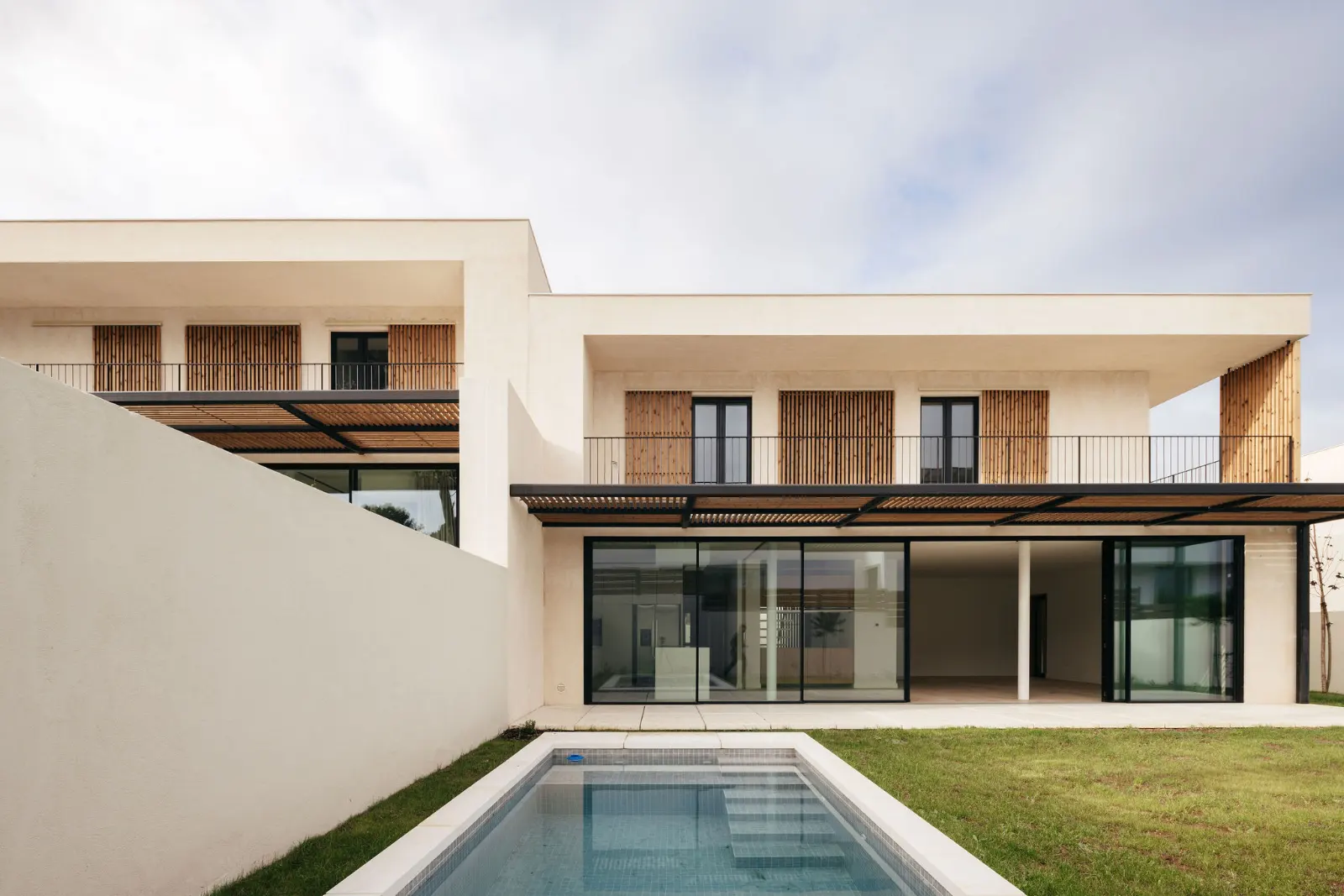
A plot with four decades of history
The subdivision where the 7 Cascas houses stand today, on Travessa dos Melros in Cascais, was officially created in 1984. It was only in 2008, after many years of negotiation between the various neighbouring owners and the Council, that the different plots were brought together into a single urban layout - because the Council never took the initiative to move forward with a detailed plan or a municipal urban plan. The amendment to the permit was registered in 2011.
In other words: between the first subdivision and the moment that plot finally had a configuration that allowed building, almost 25 years went by. And this was before a single house had been designed.
The purchase: an insolvency, not an inheritance
The land belonged to a family construction company, founded decades earlier by a businessman whom older Cascais residents still know by his first name. After his death in 2014, his children took over the business - but the long years of the subdivision process, combined with the economic situation, left the company in serious financial difficulty. In 2019, a creditor bank seized the land as part of enforcement proceedings.
It was at this stage, with a foreclosure auction hanging over the heirs' heads, that Reabilita stepped in. We bought the land in October 2020 - with the infrastructure already physically built, but not yet handed over to the Council. One essential step was still missing before any house could be designed: turning that single plot into 7 independent lots.
Dividing the land into seven: the price of 42% of the plot
The subdivision itself - the division into 7 independent lots - was formalised with Subdivision Permit no. 1500, issued by Cascais City Council on 12 March 2021.
- 945 m² (16.9%) ceded for infrastructure - roads, pavements and public parking
- 1,425 m² (25.4%) ceded for community facilities and green spaces
Even so, we fell short of the green space required - a shortfall of 604.50 m² - which we had to compensate in cash: €49,085.40. Adding that compensation to the TRIU (the Municipal Fee for Urban Infrastructure, €29,876.63) and the remaining fees, the total paid to the Council for the subdivision at this stage was €97,172.73.
- 42% of the land ceded to the municipality
- €97,172.73 in subdivision fees
- 5,600 m² original plot
This is not an administrative detail - strictly speaking, it is 42% of the land passing into municipal ownership, plus almost 100 thousand euros in fees, before we built the first wall.
Prior notification: architecture, engineering, and a race against the calendar
Only after the subdivision was closed did we start the architecture project and the engineering specialities - water, electricity, gas, telecommunications - and the corresponding approvals from the utility companies (Águas de Cascais, E-REDES, telecom operators). This took up the first half of 2021.
Each lot is legally independent, so there was not a single prior notification - there were seven, one per plot, each with its own process running in parallel at the Council. The Prior Notification for the 7 lots was submitted on 21 June 2021 (median date). The Council replied, on average, after 58 days - the preliminary review - giving only 20 days to correct what was missing. The deadline fell right in the holidays of the landscape designer, the author of precisely the element that had to be corrected. We asked for an extension, and only managed to submit the response between 19 September and 8 October 2021. Final approval came, as a median, on 25 November 2021 - about 5 months after submission.
The fees, self-assessment, and a dispute
Once the preliminary review is over, it is the Council itself that should present the fees to be paid for the building permit to become valid. But that simple act - calculating and communicating an amount - can take months. In our case, it took two.
There is, however, an alternative provided for in the law: self-assessment. Instead of waiting for the Council, the developer calculates the amount it considers due, pays it, and the permit becomes valid from then on.
"It was this self-assessment that allowed us to start work in October 2021, without waiting for the fee process, which only closed much later."
Months later, the Council presented its own calculation, with a different amount from ours. We disputed it, and after about 7 months the process closed, with a credit note in our favour.
The war nobody saw coming
In February 2022, we signed promissory contracts for the sale of the seven houses, still under construction. Weeks later, the war in Ukraine began. Over the following months, construction costs soared - almost 18% above what we had budgeted.
We had fixed prices and commitments made to our clients. We could have asked for more money, or lowered the quality of the finishes. We did neither. We absorbed the cost increase and delivered exactly what we had promised.
In the end, those who gained most from that decision were the clients themselves: with the general rise in property prices over that period, the market value of the delivered houses ended up 35% to 40% above the price at which we had sold them.
Meter boxes in the wrong place: the saga of the electrical connections
When the development was built, years before we knew exactly how each house would be designed, the meter boxes - the cabinets that house the meters - were built in positions that later did not match the final houses. Result: 5 of the 7 connections (Lots 2, 4, 5, 6 and 7) had to be physically moved.
We hired a specialist company to handle the process with E-REDES and the physical works. We paid the full quote on 7 June 2023 - more than €6,400 - with the promise that work would start that same month. A month and a half later, on 12 July, we still had neither the paperwork nor a date for the works - and without that we could not even submit the IVP (Public Road Works) request to the Council. Only after a formal written complaint did the process move forward.
Lot 6 was the most extreme case. The grid connection request had been opened on 18 April 2023, but on 24 May E-REDES marked the process as completed without the connection even being physically ready. We spent several weeks trying to correct the error without success, until we were forced to open a second request - which only in July produced the technical drawing needed for the works, now with new identification codes assigned.
The connection was physically ready in October. But when processing the refund of the fees wrongly charged on the first request - the wrong one - E-REDES mistakenly cancelled the codes of the second, correct request, leaving as "official" precisely the data from the badly handled May process. We had to update all the technical documentation and request, in December, a new electrical certificate, without which the meter could not be installed.
The Lot 6 meter was only installed on 6 December 2023 - 232 days after the first request was opened. Lots 2, 5 and 7 followed the same kind of process in around 197 to 200 days each - more than 6 months, even in the "normal" cases.
The last few metres: door numbers and the paperwork after the permit
In August 2023, with the street already in its final state - walls and gates in place - we had to apply for the door numbers.
The pace at which E-REDES connected each line set the pace at which we submitted the Use Permit applications - they can only be filed once the electricity is connected. Lots 1 and 2 were connected earliest and entered the process on 19 and 20 September 2023; Lot 7 was only ready in October, more than three weeks later.
From the Use Permit application to the Housing Technical Sheet stamped by the Council, the average was 81.3 days - with Lot 2, the fastest, closing in 65 days, and Lot 7, the slowest, taking 103.
Without that stamped sheet there is no deed - but the use permit is still not the end of the paperwork. With it, we requested the stamped plans for IMI purposes, submitted the Modelo 1 form, and waited for the Tax Authority to validate the valuation. Only then can the house be registered at the Land Registry - which, on its own, can take up to a year. Fortunately, that registration can be requested at the deed signing with the buyer, which avoids having to wait that whole year before selling.
The first house was only handed over at the end of 2023. The rest dragged on into 2024.
What this story leaves us with
From the moment we bought the land to the last house handed over, more than 3 years went by. If we count from the original 1984 subdivision, the full story of that piece of land spans almost four decades.
None of these figures appear in generic articles about licensing in Portugal - because they require going into the files, the fees paid, the days between one notification and the next. That is the exercise we set out to do in this series.
In the next article, we go to Algés, for a new-build project where the Council asked us to lower the building's ground level - and that decision, on its own, created a completely new problem.